
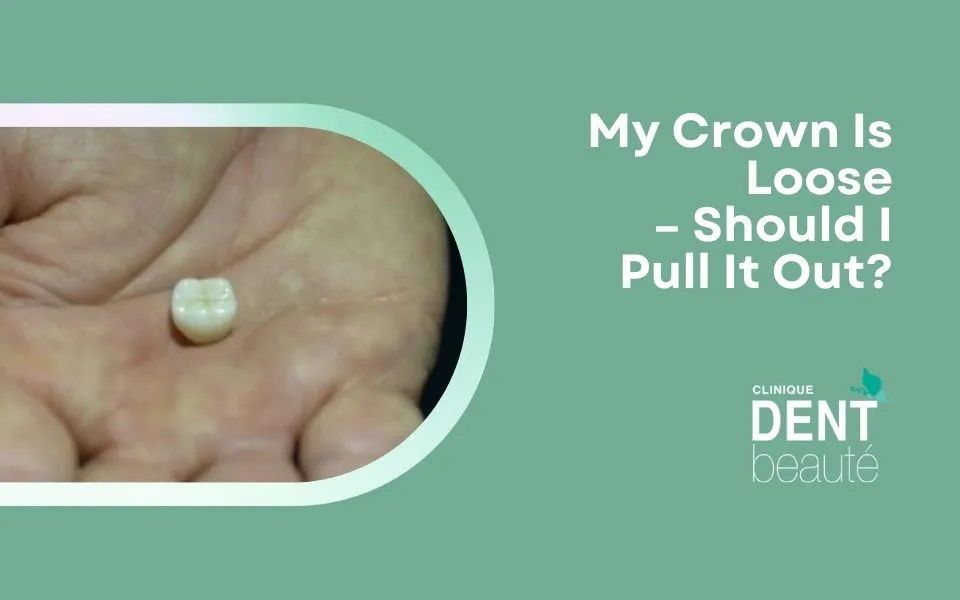
A loose dental crown is an annoying situation. Many people are faced with a dilemma when this happens: go to the dentist or try to fix it at home. To decide, let us first understand the function of a dental crown. A dental crown is not just a ‘cap’ that sits on top of the tooth. It is part of a planned treatment that protects the underlying tooth, provides a seal against bacteria, and maintains your chewing balance. Attempting to remove the crown yourself can cause much more damage than the looseness itself. The correct approach is to understand why it has become loose and have it professionally assessed before further damage occurs.
Is it normal for a dental crown to become loose over time?
Under normal circumstances, loosening of a crown is not expected. Crowns are designed to remain fixed for many years. However, the oral environment is constantly changing. Teeth may flex slightly under pressure. The cement bonding the crown to the tooth may weaken over the years. In many cases, loosening occurs due to the microscopic dissolution of the dental cement. This process can occur more rapidly in people who clench or grind their teeth, those with acidic diets, or patients with poor oral hygiene. The crown itself is often still intact, but the seal has been compromised and must be restored to prevent bacteria from entering underneath.
Additionally, a temporary crown is placed for a few days during the dental crown treatment process. This temporary crown may loosen or fall out. This is normal, as it is designed for use over just a few days.
Should you pull out a loose crown yourself?
You should never attempt to remove the crown yourself. Even if it is very loose, there may still be areas attached to the tooth. Forcing it off, especially in teeth that have previously undergone root canal treatment and become more fragile, can cause the underlying tooth structure to crack or fracture. What you are trying to remove is not a strong, intact tooth; it is a delicate tooth structure that has been shaped to support the restoration. Damaging this structure can turn a simple recementation procedure into a more complex treatment.
What happens if you remove a crown at home?
When a crown is removed without the appropriate technique, the most common result is structural damage. The underlying tooth may break or crack. Another significant risk is contamination. When a crown is exposed to saliva and bacteria for a long time, its inner surface may become unsuitable for reattachment. Dentists clean and prepare both the tooth and the crown under controlled conditions.
Common causes of a loose dental crown
A loose crown is a result, not a diagnosis in itself. The cause may simply be wear and tear over time, or it may be decay that starts at the edge of the crown over time. Crowns do not make teeth completely immune to decay. When plaque accumulates at the edge, bacteria can weaken the tooth, and often no pain is felt.
Another common cause is an imbalance in the bite. The horizontal forces generated in patients who clench or grind their teeth weaken the cement bond over time. Therefore, some patients require the use of a night guard to protect their crowns and natural teeth.
Risks of leaving a loose crown untreated
If a loose crown is left untreated, bacteria can seep under the crown and become difficult to clean. This can lead to recurrent decay, infection of the tooth structure, or failure of the previous root canal treatment.
There is also a mechanical risk. A loose crown moves during chewing. What starts as a small loosening can eventually lead to a complete loss of retention.
Is a loose crown a dental emergency?
Unless there is severe pain or swelling, it is not usually an emergency, but treatment should not be delayed. It should be examined within days, not weeks. The sooner you seek treatment, the more likely it is that the crown can simply be cleaned and reattached.
If your dental crown has fallen out, store it safely and avoid chewing on that side. Finally, if your dental crown is very loose and you are concerned about swallowing it, call your dentist for advice. If they approve of you removing the crown, do so gently.
How your dentist fixes a loose crown?
Your dentist will carefully remove the crown so they can see the tooth underneath. They will then check for decay and assess the fit of the crown. Once they are satisfied that the tooth structure is strong enough to support the crown, zirconia crown is cleaned, disinfected and reattached with strong dental cement. If there is an underlying problem, this is treated first to prevent the same problem recurring. A plan is then prepared for the replacement restoration.
Can you eat with a loose crown?
It is not advisable to eat with a loose crown. Every chewing motion causes movement in the crown, and this movement damages both the tooth and the restoration. Eating soft foods and chewing on the other side until you visit your dentist will reduce stress. Hard, sticky or very hot foods in particular can cause the crown to come out completely or lose its shape.
If you wish to receive a high-quality, long-lasting zirconia crown treatment, please contact our clinic, Clinique Dent Beauté, in Istanbul.